Monday, 16 June 2014

Personal Health Record


What is it?

A Personal Health Record (PHR) is an electronic resource containing clinical information necessary for people to be able to make decisions with regards to their health. A common feature of the PHR platforms that I have consulted is the accessibility that the patient has to a certain amount of relevant information from his/her medical records (hospital admission reports, emergency reports, lab results, etc.) Additionally there are other remarkable characteristics of PHR, not featured or adopted by all the platforms:
  • Scheduling doctor, nursing and test appointments.
  • Self-monitoring of relevant variables: blood glucose, blood pressure, physical activity, calorific intake, weight, etc. The patient is responsible for maintaining this element of the PHR. It is very useful for ‘at-risk’ and chronic patients.
  • Medication control and prescription management.
  • Access to radiology images. This is a technically sophisticated function often still under development.
  • Secure messaging Mailbox to connect with the healthcare team. See post "E–mail: it starts showing results"
  • Managing insurance policy (only American PHR).

Three American PHR
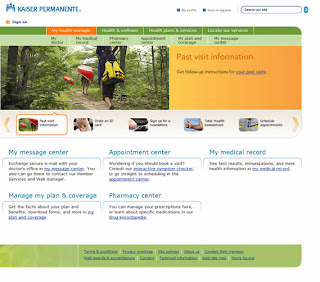
https://healthy.kaiserpermanente.org/health/care/consumer/my-health-manager


http://www.mayoclinic.org/healthmanager/art-20050589

Monday, 9 June 2014

The informed medical decision making


In this post, I’ll discuss some initiatives that began in the U.S. long before the emergence of the internet, but now, with the explosion of communication channels and social networks, these have taken on an impressive dimension that I’d like to bring to your knowledge and appreciation because, as we stand today in our environment, we are very far from these advances.

Healthwise is a U.S. company offering all kinds of solutions helping healthy people to better preserve their health and patients to better understand their disease. Many assurances, such as Kaiser Permanente, are offering Healthwise products and solutions to their members, with the aim of supporting policies of empowerment.

http://www.healthwise.org/video/sdp.aspx

Monday, 2 June 2014

E–mail: it starts showing results

Although the health system is advancing very slowly compared to other industries, I'm sure that people are ready to adopt online services and that the health care system is able to open new lines of communication in accordance with the times we live in. Success is guaranteed, provided that the professionals are willing to adapt, and this is the hard part. No wonder the banking offices and travel agencies, to take two examples, have had to redefine, from head to toe, their business models, thanks to or because of online services.

In this review of a scientific evidence program (in the scanned blue cover), the Department of Veterans Affairs in the U.S. asks the following question: What is the association between 'safe' e-mail and clinical outcomes, the patients satisfaction, the treatment adherence and the efficiency or the resource use?

But first, if I may, I’ll clarify the issue of ‘safe’ e-mail because I think it is relevant. For obvious reasons of security and confidentiality, whenever we speak of using electronic messaging to communicate between a patient and their doctor or nurse, one has to do it through a protected access, which for now is the platform of shared clinical record.

Monday, 26 May 2014

Telehealth, only expectations for now


The technology of data transmission is experiencing an explosion in all areas of social and professional activities and, of course, the specialised industry can see a big opportunity for introducing it as a tool for improving life quality of chronic patients. Doubts, however, appear in the minds of the funders of health services as they see themselves forced to adopt new investments in electronics, which have not yet been able to demonstrate good enough clinical results to compensate the effort.

Seen this way, it seemed to me that in this article about telehealth, it is appropriate to discuss two papers, one English and one Catalan, which aim to answer the question of whether the investment is worthwhile.


This article about findings from the Whole System Demonstrator, project led by Nuffield Trust researchers which sought to evaluate the clinical effect of home interventions with remote data exchange between patients and professionals (telehealth). The project was carried out with the collaboration of 3,230 patients with diabetes, COPD or heart failure from three geographical areas (Cornwall, Kent and Newham) over a 12 month period between 2008 and 2009.

Monday, 19 May 2014

HealthConnect: an electronic health record oriented to value

HealthConnect is Kaiser Permanentes’ name for their electroni health record (EHR), but first allow me to give you a brief presentation of this American insurance, so admired among health managers specially the European ones.

Brief overview of Kaiser Permanente

In 1933 Dr. Sydney Garfield established a prepaid health plan model for workers on an aqueduct in California’s desert. Later, in 1938, Henry Kaiser persuaded Dr. Garfield to extend the experience to other groups of workers, both in California and Washington. Immediately after the war ended, in 1945, the Kaiser-Garfield health plans opened to the general public. These health plans were based, in the beginning, on a reciprocal prepaid model, a care group practice, a population view of prevention and shared clinical information. This pattern contrasted sharply with other policies, in a country that represented and continues to represent the epitome of payment per service.

Today, Kaiser is an insurance that functions through a stable agreement with a doctors’ company called Permanente. It has 9 million members in 9 states, 36 hospitals, 533 health centres, 170,000 employees plus 16,000 physicians in Permanente, a budget of $48,000 M and $2,000 M of benefits (2011).

Monday, 12 May 2014

Back to Sutton’s Law


Last week we saw the status quo bias starting from the article "Assessing Value in Health Care Programs". Remember that this bias is due to the human tendency to keep doing things as usual, without questioning too much the meaning of what is being done.

But in this post I want to talk about exactly the opposite innovative attitude and the difficulties inherent to the changes in an environment as segmented and as regulated as the health system. For this reason I have chosen three examples that illustrate the obstacles that many professionals must overcome when they are eager to change routines or adopt a new drug they know is supported by scientific evidence. But the problem is that to adopt the novelty, investments are required, or simply more budget because the new drug is more expensive. So the question is: who pays for the novelty when we were told that we can not spend more?


Example 1 - Adherence to treatment


Let’s consider a program that may improve adherence to treatment, which barely reaches 45%, after myocardial infarction (Volpp 2012). Let’s imagine that a new program foresees increasing this adherence to up to 70% and as a result there would be a 10% reduction in readmissions both for new myocardial infarction and for stroke or revascularization, with a cost reduction that could collect savings for the association of $2,000 per case per year. Does this mean that the program should not be approved if its cost would be $3,000 per case and year?

Monday, 5 May 2014

The status quo bias


I like this JAMA (Volpp 2012) article because it raises the issue of the status quo and this is well-timed because just for now, we are accustomed to the debates on the introduction of new technologies or new drugs, and maybe that's why we’re now starting to evaluate the opportunity of innovation in terms of cost-efficiency or even cost-effectiveness. I’m talking about the $150,000 from the introduction of trastuzumab in metastatic cases of breast cancer per year of life gained, or the $370,000 of the use of erlotinib for advanced cancer of the pancreas cases (Weinstein 2010). But the question of the status quo is: are we wondering about the cost–effectiveness of clinical activities that are undertaken every day, or is that the status quo of having achieved a position in the portfolio of services, puts them at safety from doubts?

To illustrate the status quo, without going in-depth, I chose a couple of examples from the field of preventive activities and a couple more from the supposedly curative care activities.

Example 1 - PSA

Almost all health care assurances, both public and private, offer to men of 50 years of age, the opportunity to get an annual PSA test (Prostate Specific Antigen). It doesn’t seem to be a particularly expensive test, but now the controversy focuses on the disadvantages of early detection, because, according to experts, it’s not clear that this will bring more life to patients, but it does seem however, the resulting overtreatment can cause new problems in their daily life (incontinence, impotence). Expert groups claim to inform the men very well about all this prior to taking the test, but the assurances stubbornly continue to offer the annual PSA in its preventive portfolio without further consideration.

In case you are interested in this issue I offer the link to the U.S. National Cancer Institute.