Showing posts with label Overdiagnosis. Show all posts

Monday, 3 May 2021

Could test cascades be avoided after an incidental finding?

Jordi Varela
Editor


Incidental findings resulting from a diagnostic test or screening are being a headache for modern medicine, a problem that is only growing hand in hand with the refinement of imaging technology and genomics. In some cases, the investigations that follow the incidental findings indicate the existence of silent pathologies, or in the initial phase, and timely clinical intervention is effective, although in often, the cascades of tests that are derived end up being unproductive, as well as potentially dangerous, for patients. It’s a phenomenon that generates anguish in hypothetical patients and burnout in professionals, who don’t know how to stop it, since once there is a probability that what is found is dangerous, the pressure to reach the end is unstoppable. Unfortunately, the evidence shows that there is no evidence that compliance with clinical practice guidelines is capable of ending these cascades once they have started and, on the other hand, it has not been possible to demonstrate that the establishment of economic penalties or co-payments can stop the phenomenon.

Monday, 24 August 2020

Reducing Overprescription with Psychology based Interventions

Pedro Rey


There exits consensus about drug overprescription having become a significant public health problem, both for its health effects and for its budgetary repercussions. The case of the opioid "epidemic" in the United States frequently comes under scrutiny. We must not forget the abuse of benzodiazepines (especially) during hospital treatment or the loss of efficacy of antibiotics due to the development and selection of bacteria that developed resistance due to improper and excessive use. Traditional methods of combating these problems have been to try to educate both the medical profession and patients, to train prescribers or to review prescribing practices and create automated alert systems. However, although in some cases these measures have been relatively successful in the short term, they have also been shown to be not cost-effective, to lose efficacy in the medium term, and to be challenging to transfer to significant interventions.

Monday, 17 February 2020

Is my child hyperactive or is it simply that he is too small?

Pedro Rey


Parents are increasingly worried about their children being been diagnosed with attention deficit hyperactivity syndrome (ADHD). In fact, in the United States, the proportion of children between two and five years who were diagnosed with this syndrome increased by more than 50% from 2007 to 2012. It is estimated that in 2016 the worldwide prevalence of ADHD diagnosis in children under 18 years old was 5% and in the United States, for example, 5.2% of children of these ages take medication. Spain is one of the main consuming countries of methylphenidate, one of the medicines used to treat ADHD, whose consumption has multiplied by more than 30 in the last 15 years.

Monday, 6 January 2020

30% of digestive endoscopies have questionable indications


@varelalaf
In an article in the series "Less is More" by Gastroenterology, three digestiologists, Shaheen, Fennerty and Bergman, after an extensive review of the literature, conclude that 30% of digestive endoscopies have questionable indications. According to the authors, many clinical practice guidelines stimulate the exaggerated consumption of these tests in clinical situations of doubtful indication, such as recommendations for the follow-up of low-risk patients of Barrett's disease (oesophageal reflux), which they say they are "carefully misleading." On the other hand, the prevailing cancer phobia places a lot of pressure on the examination rooms, which are permanently overwhelmed, not only by inappropriate requests but by follow-up guidelines that anticipate the requirements demanded by the clinical practice guidelines themselves.

Monday, 21 October 2019

The early diagnosis of colorectal cancer, thirty years later


@varelalaf
Health systems have long-planned population programs for the early detection of certain cancers through diagnostic techniques arising from the clinical setting, such as prostate-specific antigen (PSA), mammograms, ultrasound or the study of faecal occult blood that is the case at hand. This issue is generating confusion in society because one thing is to take care of one's health and the other, quite different, is to undergo medical tests to discover tumours in their early stages. On the other hand, discomforts are also generated among professionals, because it’s not the same to treat patients who seek help for health problems, than to propose extensive tests to the healthy population.

Monday, 12 November 2018

Should we statinize society?


A 2011 Cochrane review concluded that there was not enough evidence to prescribe statins for people with a cardiovascular risk of less than 20% in 10 years, a claim that was consistent with the British NICE guideline (2006-2008) and with the American Heart Association (2011). The surprise came when, unexpectedly, the 2013 Cochrane review changed its mind and lowered the statin threshold to the 10% risk at 10 years, a recommendation that was quickly adopted by the NICE guidelines.

Strongly opposed to this change of approach, John Abramson (Harvard Medical School), and collaborators, in "Should people at low risk of cardiovascular disease take a statin?" ensure that with the criteria of 2011, in the population over 60 years, it would have been necessary to statin 16% of women and 48% of men, but with the recommendations of 2013 the market was extended to practically all the population of older people, given that age is the most influential cardiovascular risk variable in risk calculators. The authors have reviewed the meta-analysis that led to the change of criteria ("The effects of lowering LDL cholesterol with statin therapy in people at low risk of vascular disease: meta-analysis of individual data from 27 randomized trials") and have reached conclusions that contradict the Cochrane recommendations of 2013:

Monday, 20 August 2018

The ancestral optimism and the perfect storm


The optimism of patients

When people get ill, or are afraid of being ill, as a rule we tend to trust doctors and by extension, health systems. But do we really benefit? A systematic review, developed by researchers from the Centre for Research in Evidence-Based Practice of Bond University (Australia), based on 35 surveys (27,323 patients as a whole) concludes that 88% of people overestimate the real benefits of the clinical actions, while 67% underestimated the adverse effects.

See for example, the expectations of people in being able to reduce the risk of dying from secondary prevention programs for breast, prostate and bowel cancers are far above the real data. The dark part of the bars corresponds to the percentage of respondents who overestimate the benefits of the respective preventive tests, and the crosses on the right indicate for which of them this percentage is equal to or greater than 50%.

Monday, 28 May 2018

Overdiagnosis in depression: there are doors better left closed

Andrés Fontalba


A young Cecilia, aged 13, in Sofia Coppola's brilliant film based on the homonymous novel, "The suicide virgins" advised:

-Obviously doctor, you were never a 13-year-old girl.

It’s obvious that depression in children and adolescents is an important cause of disability and generates great suffering for the person and his or her environment, requiring specific management adapted to the needs of that peculiar age. Based on the severity of this pathology, the availability of effective screening tools in the detection of depression, and a treatment that improves prognosis, the United States Preventive Task Force in 2009 recommended the screening for depression in all adolescents in a medical and integrated with mental health services setting, despite not having any previous trials that would justify this intervention.

Monday, 19 February 2018

What are the objectives of cancer prevention programs?


Vinay Prasad and Adam Cifu in "Ending Medical Reversal, Improving outcomes, Saving lives" affirmed that in order to interpret the meaning of secondary cancer prevention programs, three objectives must be kept in mind: 1) cancer ought to be discovered ahead of time, 2) specific mortality ought to be reduced and 3) overall mortality should be decreased.

The authors say that what really matters is objective number 3, given that the first two are purely instrumental. After all, if a healthy person accepts a screening, this is supposed to be because he or she wants to live longer. Unfortunately, the data shows that preventive programs (cancer of the colon, prostate, breast, cervix and lung) obtain the following results (with small nuances among them): a) objective 1: achieved, b) objective 2: weak, and c) objective 3: not reached.

Monday, 30 October 2017

Prediabetes epidemic in sight


Prediabetes is a terminology that, recently, is used when a person is detected with higher than normal levels of blood glucose, but there is no pathology. Prediabetes could be understood as a disposition to develop diabetes in the future, a disease that, in turn, represents a condition that puts one at risk of serious affections such as nephropathy, retinopathy or cardiovascular disorders, among others. Due to this chain of risks, and with a healthy intention to reduce morbidity and mortality, the American Diabetes Association (ADA) led a study to consider that glycosylated haemoglobin (HbA1c) is a test that can be done without any preparation or need for fasting and see if it can become a new criterion for detecting prediabetes. The concern arises when, according to this diagnostic extension, it’s estimated that in millions of pre-diabetics would show up: in China 493, in the US 86 and in Spain 6, to cite three countries from which I have data.

Monday, 8 May 2017

What if I decide to do nothing?


TIME magazine has surprised us with a question on its front page: "What would happen if I decided to do nothing?" Desiree Basila, a 60-year-old teacher, had just been diagnosed with ductal carcinoma in situ (DCIS) and, overwhelmed by the aggressiveness of the treatment proposals offered to her, began to investigate on her own and realized that there were many unknown elements about the progression of this type of injury and also saw that there was no agreement in the scientific community on what should be the most appropriate therapy for her case. For this reason she made a bold decision and asked her oncologist to do nothing, which resulted in two checks a year and a treatment with Tamoxifen, a drug that blocks estrogens that could cause the tumour to grow.

The case of Desiree Basila is quite valuable because when she made this decision, 8 years ago, it was not yet known that the mortality of women with DCIS, regardless of the type of treatment they adopt, is 3.3%, a figure comparable to that of the general population, and it was also not known that chemotherapy has no effect on tumours in initial staging. But to better understand the pressure that Desiree had to endure, it should be added that the attitude of most oncologists, even in the case of DCIS, was, and remains, "the sooner the better and the more the better."

Monday, 3 April 2017

Overdiagnosis: the case of thyroid cancer


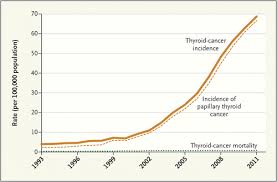
The thyroid cancer rate has doubled or possible tripled in the last twenty years in most Western countries; however there’s a paradigmatic case, according to an article published in New England by Ahn HS and collaborators: South Korea, where this rate has multiplied by fifteen. What has happened in this country? Is there an epidemic? This should not be the case given that when experts analyse specific population mortality (as shown in the chart), this figure remains unchanged. Therefore, everything points to a spectacular case of national over-diagnosis.

The authors explain that many government-encouraged providers offer very attractive and widely accepted preventive packs, including the use of ultrasound and other more sophisticated imaging tests for the early detection of thyroid cancer. It should be clarified that in South Korea, despite there being a national health system, there are co-payments for almost all health activities and as a consequence people pay close attention to the price of combined service offerings.

Monday, 7 November 2016

Basic instruments for clinical management


In preparing this post I have chosen nine references which, in my opinion, have been milestones in the development of methodologies and tools that have shaped clinical management as we understand it today. To make it more understandable, I have framed these milestones in 5 relevant periods: the introduction of the concepts of quality in the 60s, the protocols in the 70s, the consensus in the 80s, the evidence of 90s and the safety of patients in the first decade of this century.


Monday, 26 September 2016

When the overdiagnosis is politicized


Rudy Giuliani, the Republican mayor of New York, on that fateful September 11, at an election meeting said: "I had prostate cancer 5 or 6 years ago and I thank God to be an American citizen because here the probability of survival at five years for this cancer is 82%, while in the UK, due to socialized medicine, this value is only 44%." We must clarify that in the US, PSA screening is widespread while in the UK it’s not so. According to Gerd Gigerenzer (I have extracted this case from his book "Risk Savvy"); Giuliani’s words conceal a big mistake, because in reality, although it seems a contradiction, mortality from prostate cancer in the two countries is practically the same. So how is it possible that the survival rates are so different? To explain it, Gigerenzer describes two biases that encourage the intentional error of the conservative politician:

Monday, 30 March 2015

Overdiagnosis: in relation with pulmonary embolism


The introduction of computed tomographic pulmonary angiography (CTPA) for the diagnosis of pulmonary embolism, according to a study published in JAMA Internal Medicine (US data), has been associated with an increase of 80% in the incidence of pathology (from 62.1 to 112.3 per 100,000 population p<0.001), with a reduction in hospital mortality of 35% (from 12.1% to 7.8% p<0.001), which lamentably only has led to a decrease in mortality rates of 3% (from 12.3 to 11.9 deaths per 100,000 p=0.02) and also lamentably, an increase in presumed complications of anticoagulation therapy of 71% (from 3.1% to 5.3% per 100,000 p<0.001).

In the graph below, taken from the article, you can see the behaviour of the incidence of pulmonary embolism in relation to mortality, both population-based, comparing the 1993-1998 period, prior to the introduction of CTPA, with the subsequent one. The overall incidence (bright blue) includes all patients admitted to the hospital for any medical or surgical circumstance. The percentages represent average increases for each year (APC: Annual Percentage Change).


Monday, 23 March 2015

How to diagnose overdiagnosis

In a BMJ editorial, within the framework of the campaign "Too much medicine," Professor Paul Glasziou and editor Fiona Godlee, among others, spoke of the phenomenon of overdiagnosis and analysing their characteristics, and since this is a trending concept, I think it's a good idea to pay attention to it.

In a medicine previous to cancer screening programs as we know them today, people were diagnosed according to the appearance of the first symptoms. It was the visible tip of the iceberg. But as it was suspected that when the symptoms appeared, the illness simmered below the clinical perception for long time, it was believed it was necessary to develop diagnostic techniques to allow seeing the iceberg below the water, with the assumption that the sooner the pathological process in motion is detected the sooner is possible to act, therefore obtaining a better prognosis.

But now we can see that things did not fully go as intended. In general, we can affirm that thanks to screening programs forecasts have improved, but unfortunately the mortality rates are the same, and voices criticizing this rummaging through the invisible parts of the iceberg, have enough arguments to defend that while early diagnosis may detect many cases that perhaps wouldn’t have emerged at all, this is done at the expense of improving survival rates in an artificial way.

Monday, 20 October 2014

New diseases: new?


Enrique Gavilán is a family physician who has a habit of providing good professional quality "material" on Twitter, especially with regards to evidence in overdiagnosis and overtreatment.

On this occasion, I have chosen a tweet from Dr Gavilán which refers to a work published in "PLOS Medicine" that analyzes 16 studies where there have been criteria changes in the diagnostic definitions of common diseases such as: hypertension, asthma, attention deficit hyperactivity disorder (ADHD), COPD and dementia, among others.

One finding of the study was that these changes in criteria were mainly in three directions: creation of pre-conditions, lowering superior analytical values ​​and introduction of methods of early diagnosis. Another discovery is that these changes in criteria, which only serve to increase the legion of people affected by supposedly pathological conditions, are not accompanied by evaluations of the negative or even harmful impact to the health of "new patients". And there's a final finding: many of these studies have been developed by researchers with an economic interest linked to pharmaceutical companies directly involved in the proposed criteria changes.


Jordi Varela
Editor