Showing posts with label Share Decision Making. Show all posts

Monday, 18 May 2015

Persuasion is not the way to changing behaviours


Harvard Business Review’s tweet links back to their own blog where you’ll find a post signed by Art Markman, a professor at the University of Texas and author of "Smart Thinking"  a book about traditional topics of marketing on how to change attitudes and ultimately sell more and for this reason the first thing I thought of when reading the promotional post of the book was that these are issues specific to the commercial world, so far from clinical management. But then I gave it another try and suddenly I found an interest in the author’s approach to the topic.

Monday, 8 December 2014

Medicine focused on patient preference: visual aids


Some argue that the great innovation in this second decade of the twenty first century should be medicine based on patient preference. To understand it better, it’s about women being well informed of all probabilistic knowledge regarding the decision to have a mammogram screening or not. Therefore it is the woman who takes responsibility for her decision and not the government or insurance company of her choice. The same would be said for men and the PSA.

This approach would seem reasonable enough, if it were not for the fact that, according to a particular US survey (National Adult Literacy Survey), half of the population has difficulty in managing simple numerical operations. For this reason I have chosen this blog post by Kevin Pho, who has always been innovative in the field of clinical management, who presents an article by Peter Wei, a medical student, who gives us a visual aid developed by the Mayo Clinic. You can argue that those who struggle with mathematical operations will also have difficulties interpreting graphs, but if the graphics are designed to be understood its less of an issue and if that is not the case, consider the following:

Monday, 22 September 2014

The heuristic effect on shared clinical decision


The Commonwealth Fund is a private, nearly century old organization that was created with the mission of promoting efficiency, quality and accessibility of the American health system.

Our tweet of the week, issued by the foundation, brings us to a very interesting article written by Lisa Rosenbaum, cardiologist, and published in "The New Yorker", where she uses several examples from her own practice to illustrate the difficulty of the exercise of "shared clinical decision." One of the cases discussed is that of her own mother, a cardiologist like her, who broke her arm in four places, and when faced with the severity of fractures, the orthopaedic surgeons advised her that she consider the possibility of surgery, which included a risk of between 20 and 50% of developing avascular necrosis of bone, while, if following a conservative treatment with immobilization and subsequent rehabilitation there was a risk, not estimated numerically, of  residual functional limitation and post-traumatic arthritis.

As Dr. Rosenbaum says in the article that the "shared clinical decision" is a very attractive proposition for politicians, investors and researchers, but, instead, in practice each day, the doctor who practices this technique faces two phenomena that are very difficult to handle: the first is called "heuristic effect", a concept that reflects the idea that us people, at decision time, allow ourselves to be influenced more by emotion than by the figures, such as: "a friend of mine died in the operating room and therefore no matter what they say, the doctor will not trick me", or the opposite: "the upstairs neighbour was operated on when it was too late to save her leg. I'll have to talk to the doctor to see if they should send me to the operating room". The second phenomenon is the unequal agency relationship established with the patient, and this is expressed when at the end, after sharing lots of information and lots of numbers, the patient looks at the doctor and asks, "Doctor, if it was your mother, what would you do?” Or as the author writes "You're my quarterback. Do you understand?".


Jordi Varela
Editor

Monday, 9 June 2014

The informed medical decision making


In this post, I’ll discuss some initiatives that began in the U.S. long before the emergence of the internet, but now, with the explosion of communication channels and social networks, these have taken on an impressive dimension that I’d like to bring to your knowledge and appreciation because, as we stand today in our environment, we are very far from these advances.

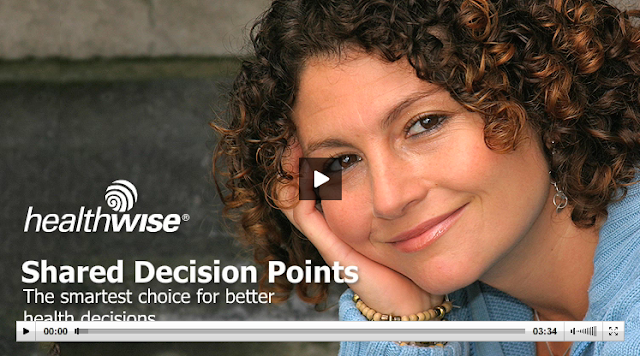
Healthwise is a U.S. company offering all kinds of solutions helping healthy people to better preserve their health and patients to better understand their disease. Many assurances, such as Kaiser Permanente, are offering Healthwise products and solutions to their members, with the aim of supporting policies of empowerment.

http://www.healthwise.org/video/sdp.aspx

Friday, 21 February 2014

"The Surgical Signature" and how the patients can influence the overtreatment


In his latest book, Tracking Medicine, presented in the first post of this blog, Wennberg says that it’s possible to recognize a hospital by their rates of interventions profile (population-based) from a small handful of surgical procedures. And he demonstrates it with the following graph:


The analysis of the 5 selected areas in this 1975 work shows the profile of five surgical procedures ("The Surgical Signature") of each of them. So you can see that the men of Portland have the highest probability of the series to be undergoing prostatectomy (50% above the average), while citizens of the same Portland, in general, have the lower odds of having haemorrhoidectomy (40% below the average), Lewiston women face the highest rates of hysterectomy (60% above), in Augusta the average varicose extractions doubles, Waterville is the champion in operating haemorrhoids (nearly triples average) and finally the Bangor area is only notable for having the lowest rates of prostatectomy’s series.

The paper concludes that variations in the use of surgical resources are observed not only in comparisons between systems (see previous post) but also, the phenomenon has a land mark that does not correspond with the socio-demographic characteristics (which are adjusted) nor with the prevalence of diseases susceptible to surgical intervention.