Showing posts with label ITC. Show all posts

Monday, 1 April 2019

Blockchain and crypto management

Tino Martí


In the 2018 edition of the Mobile World Congress has drawn to a close. Among the different technologies exhibited this week at the mobile fair, the chain of blocks or blockchain has appeared tangentially. Announced as the new revolution in the digital world - which some consider as disruptive as the internet - the block chain is the technology that allows the popular bitcoin crypto currency to work and whose value has reached unimaginable value (exceeded $ 18,000 last December).

But what is really the block chain and how can it be of interest to the readers of Advances in Clinical Management?

Blockchain is a distributed database system that allows transactions between agents to be both secure and anonymous by means of a trusted timestamp in the distributed public registry (distributed ledger). Although its best known application is to carry out operations with cryptocurrencies such as bitcoin or ethereum, the chain of blocks can also be used to manage valuable elements such as certificates, insurance or votes, and is being widely experienced in different sectors such as finance, logistics or food.

Wednesday, 28 November 2018

Technological disruption in health

Salvador Casado


We all talk about the technological revolution being witness about how it is transforming our environment. First there were the travel agencies, then the taxis, later the tourist apartments rental, o online shopping, online education...

However, one question remains to be answered: how will health disruption affect health systems and their professionals and users?

From my point of view we can know something: the change will be progressive and will come from the successive implementation of technologies that provide advances in different aspects of clinical practice, management and organization of resources. We also know that health systems are huge organisations with high inertia and that health professionals tend to have a conservative profile when it comes to incorporating new technologies. Before we adopt them we need to have scientific evidence that is both useful and beneficial to the patient and society. The problem is that scientific evidence is costly and very slow. The average time for a new molecule to become an accepted drug is about ten years, which is unreasonable for products and services in the digital sphere.

Monday, 16 June 2014

Personal Health Record


What is it?

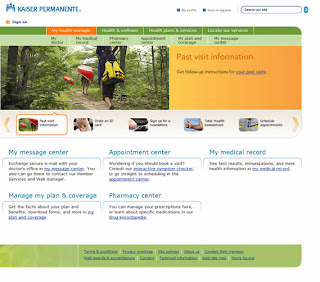
A Personal Health Record (PHR) is an electronic resource containing clinical information necessary for people to be able to make decisions with regards to their health. A common feature of the PHR platforms that I have consulted is the accessibility that the patient has to a certain amount of relevant information from his/her medical records (hospital admission reports, emergency reports, lab results, etc.) Additionally there are other remarkable characteristics of PHR, not featured or adopted by all the platforms:
  • Scheduling doctor, nursing and test appointments.
  • Self-monitoring of relevant variables: blood glucose, blood pressure, physical activity, calorific intake, weight, etc. The patient is responsible for maintaining this element of the PHR. It is very useful for ‘at-risk’ and chronic patients.
  • Medication control and prescription management.
  • Access to radiology images. This is a technically sophisticated function often still under development.
  • Secure messaging Mailbox to connect with the healthcare team. See post "E–mail: it starts showing results"
  • Managing insurance policy (only American PHR).

Three American PHR

https://healthy.kaiserpermanente.org/health/care/consumer/my-health-manager


http://www.mayoclinic.org/healthmanager/art-20050589

Monday, 2 June 2014

E–mail: it starts showing results

Although the health system is advancing very slowly compared to other industries, I'm sure that people are ready to adopt online services and that the health care system is able to open new lines of communication in accordance with the times we live in. Success is guaranteed, provided that the professionals are willing to adapt, and this is the hard part. No wonder the banking offices and travel agencies, to take two examples, have had to redefine, from head to toe, their business models, thanks to or because of online services.

In this review of a scientific evidence program (in the scanned blue cover), the Department of Veterans Affairs in the U.S. asks the following question: What is the association between 'safe' e-mail and clinical outcomes, the patients satisfaction, the treatment adherence and the efficiency or the resource use?

But first, if I may, I’ll clarify the issue of ‘safe’ e-mail because I think it is relevant. For obvious reasons of security and confidentiality, whenever we speak of using electronic messaging to communicate between a patient and their doctor or nurse, one has to do it through a protected access, which for now is the platform of shared clinical record.

Monday, 26 May 2014

Telehealth, only expectations for now


The technology of data transmission is experiencing an explosion in all areas of social and professional activities and, of course, the specialised industry can see a big opportunity for introducing it as a tool for improving life quality of chronic patients. Doubts, however, appear in the minds of the funders of health services as they see themselves forced to adopt new investments in electronics, which have not yet been able to demonstrate good enough clinical results to compensate the effort.

Seen this way, it seemed to me that in this article about telehealth, it is appropriate to discuss two papers, one English and one Catalan, which aim to answer the question of whether the investment is worthwhile.


This article about findings from the Whole System Demonstrator, project led by Nuffield Trust researchers which sought to evaluate the clinical effect of home interventions with remote data exchange between patients and professionals (telehealth). The project was carried out with the collaboration of 3,230 patients with diabetes, COPD or heart failure from three geographical areas (Cornwall, Kent and Newham) over a 12 month period between 2008 and 2009.

Monday, 19 May 2014

HealthConnect: an electronic health record oriented to value

HealthConnect is Kaiser Permanentes’ name for their electroni health record (EHR), but first allow me to give you a brief presentation of this American insurance, so admired among health managers specially the European ones.

Brief overview of Kaiser Permanente

In 1933 Dr. Sydney Garfield established a prepaid health plan model for workers on an aqueduct in California’s desert. Later, in 1938, Henry Kaiser persuaded Dr. Garfield to extend the experience to other groups of workers, both in California and Washington. Immediately after the war ended, in 1945, the Kaiser-Garfield health plans opened to the general public. These health plans were based, in the beginning, on a reciprocal prepaid model, a care group practice, a population view of prevention and shared clinical information. This pattern contrasted sharply with other policies, in a country that represented and continues to represent the epitome of payment per service.

Today, Kaiser is an insurance that functions through a stable agreement with a doctors’ company called Permanente. It has 9 million members in 9 states, 36 hospitals, 533 health centres, 170,000 employees plus 16,000 physicians in Permanente, a budget of $48,000 M and $2,000 M of benefits (2011).