Showing posts with label Bohmer R.. Show all posts

Monday, 20 September 2021

Five-point plan to increase the value of clinical practice

Jordi Varela
Editor


In an article recently published in Clinical Medicine, Five recommendations to increase the value of clinical practice, I proposed a plan with a view to a more valuable clinical practice and, given the timely topic, I allow myself to partly reproduce in this post. You should note that this plan does not support pilot tests or halftones, but should be implemented with a perspective of in-depth organizational change, aiming to generate an institutional profile of value and excellence.

Monday, 24 October 2016

Modern clinical management: the basics


In recent decades, clinical management has had a couple of conceptual disruptions that have generated interest in the welfare act as an object of study. The first was when, in the early 90s a group of epidemiologists moved clinical epidemiology from the academy to the consultation and developed evidence-based medicine; and the second came when governments and health professionals became knowledgeable about the clinical work’s ability to do harm. The "To err is human" from the Institute of Medicine report in late 1999 was the turning point of patient safety programs. Now, in the second decade of the century, starting from those two fundaments (security and evidence), all the interest is in knowing what is the value that clinical practice brings to the health of people.

The conceptual foundations of modern clinical management


Monday, 22 August 2016

Big Med or wholesale medicine


A few months ago, Josep Maria Monguet published a post on this blog about the low cost medicine in India, and along these lines I thought it would be interesting to comment on an article by Atul Gawande in the New Yorker with some comparative reflections between medicine and restaurant chains. "In medicine -says Gawande- try to provide a wide range of services to millions of people at reasonable costs and an acceptable level of quality, but the reality is different: the costs continue to rise, the service we offer is mediocre and the quality, uneven. Each doctor has his own way of doing things and the variations in the results, even within the same health centre, are inexplicable.

Dave Luz, regional manager at the Cheesecake Factory in the Boston area, explains to Gawande that his mother, with advanced Alzheimer's, fell down at home the other day and has been taken to the emergency room, where doctors visited her, did various tests and kept her under observation for the night. Luz received three types of explanations: from the emergency physicians, from the internist at the observation room and from a specialist, and these were not exactly coincident. He soon realized that there was no plan involved there. The next morning, a nurse told him that his mother was fine and that they would prepare her for discharge but because the nurse in charge was having her breakfast, they would have to wait, and that process, seemingly bureaucratic lasted until the afternoon because the doctor who had to make the discharge report could not be found. To cap it all, when it was time to dress his mother, the auxiliary disappeared and Luz had to fend for himself. With the discharge papers, he would schedule a control visit to collect the results of urine tests and one to see a neurologist. A couple of weeks later, the neurologist, after an examination that lasted a couple of minutes, called for new tests (by the way some matched those that had been made in the emergency services) and prescribed some medication that, once asked what they are for he admitted they‘re useless. Dave Luz says that this kind of disorganization among professionals and circuits, this lack of an overall plan, was to be found everywhere where he had to go to accompany his mother for receiving medical care.

Monday, 1 August 2016

The four habits of high value health care organizations, according to Richard Bohmer


In an article in Harvard Business Review, Fixing Health Care on the Front Lines, Richard Bohmer presented the three pillars of modern clinical management (see post: Clinical management as a mechanism of change). I like Bohmer’s contributions because he always looks at what can be done to bring the concepts to the real world, so it has seemed appropriate to comment on another one of his articles published in NEJM, The Four Habits of High-Value Health Care Organizations, which raises the logical point: if you want to encourage high value clinical practices, high value health organizations are paramount and for this reason, the author has studied the ways of working of the US healthcare institutions that are showing the best results in clinical and cost effectiveness (referencing the outcomes of Michael Porter) and he extracted 4 habits that, according to him, should be exportable:

Monday, 11 July 2016

Clinical management as a mechanism of change, according to Richard Bohmer


Richard Bohmer is a doctor, a professor at Harvard Business School and the author of "Designing Care". In his article, Fixing Health Care on the Front Lines, Bohmer defines the three pillars that should underlie modern clinical management, in short, these are: a) thoroughly implement the best practices, b) address the complex processes with mechanisms of trial and error, and c) learn from daily activity. "Almost none of the health organization is prepared to excel in these three pillars nowadays, says the author. In fact, most clinical services providers lack the capacity to adapt to the challenges imposed by science, innovation and social pressure, unlike what happens in other industries, constantly reengineering their models to suit the changing needs of their business core".

Rigorously implementing the best practices

The clinical practice guidelines (CPG) and the recommendations supported by strong evidence should translate in care routes (see Care Delivery Value Chain). Modern organizations know that the GPC are not only a matter regarding the medical profession, so they invest a lot of effort in the development of plans to make them feasible. Anyone even slightly concerned must be involved. Transforming a GPC into an operating process is equivalent with improving clinical effectiveness. Some examples: a) applying industrial methods to standard cardiac surgery processes at the Mayo Clinic, b) the myocardial codes and stroke codes that, in many regions, have been deployed with excellent results and c) development of organizational models that aim to reduce resistance to antibiotics (PROA) or to avoid unnecessary blood transfusions (PBM).

Addressing the complex processes with mechanisms of trial and error

A significant number of patients are suffering with pathologies that are not well known or show complexities resulting from a combination of clinical or even social circumstances that are difficult to manage. For these cases, the organizational response is teamwork which aims to find specific solutions while the actions will have to be adjusted by trial and error methods. Some examples: a) advancing the introduction of palliative care in cancer patients who are still following therapeutic healing guidelines, b) reconciling patient medication when transferring between hospital and primary care, and c) developing individualized therapeutic plans for complex chronic patients.

Learning from daily activity

The other day, in a class, I came across a few permanent and non-permanent markers and, as it happens, without realizing it, I ended up ruining the whiteboard. At the end of the class, I sincerely apologised to the head of the classroom and suggested that it would be a good idea, for the sake of their class boards, to withdraw the permanent markers, but the response I’ve got was one of those type "here we, always have done things this way". I assumed that they must go through a change of budgets in order to make changes in the classroom stationery. However to improve every day, is above all, a question of attitude. Some examples: a) in an office, faced with the fact that 20% of scheduled patients do not keep their appointment, a working group was created in order to analyse the causes and find solutions, b) in a hospital, ward nurses make proposals to be able to shift from intravenous to oral medications as soon as possible, regardless of the oversights of medical orders, and c) in an emergency department, they organize daily huddles to ensure that all the professionals can share their opinion on what happened that day and advance proposals to avoid the same problems reoccurring.

When we talk about structural reforms, I suspect that not everybody says the same thing. Many think of labour rights, or in financing or investment. These and other aspects are important, which is why the health care system has a recognized complexity. But make no mistake, only from the clinical management can the effectiveness and resource optimization can be improved. As Bohmer advocates, organizations, with doctors and nurses included, should apply best practices rigorously, should learn to make decisions as a team when the issues are peculiar and ought to have the appropriate attitude in order to change everyday things.


Jordi Varela
Editor

Monday, 7 July 2014

Professional confederacy for clinical effectiveness


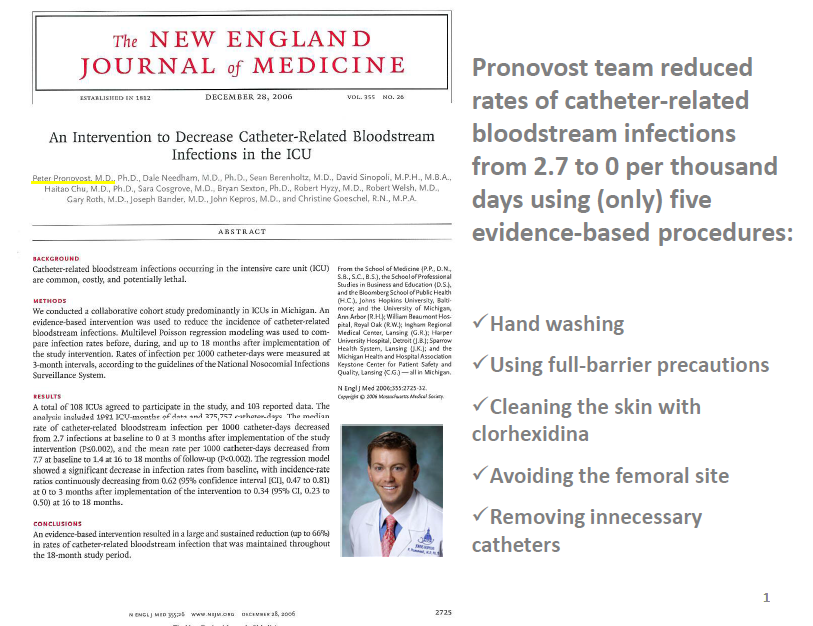
Clinical practice guidelines often struggle to implement a mandate in the world of real medicine. For this reason, the initiatives born in the professional world that rely on instruments within reach such as persuasion, training and clinical audit are genuinely remarkable.

To illustrate what I mean, I have chosen three projects from the sensitive field of hospital infections. The first is from a team of intensive care specialists in Michigan, the second of a group of Spanish intensivists lead by Mutua de Terrassa and the third of a multidisciplinary group from Sevilla.