

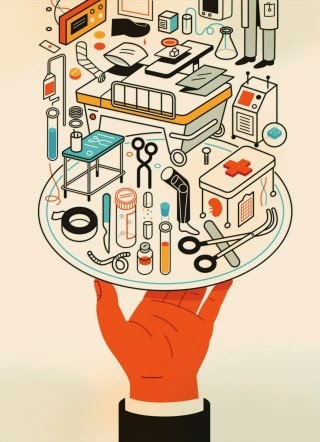
A few months ago, Josep Maria Monguet published a post on this blog about the low cost medicine in India, and along these lines I thought it would be interesting to comment on an article by Atul Gawande in the New Yorker with some comparative reflections between medicine and restaurant chains. "In medicine -says Gawande- try to provide a wide range of services to millions of people at reasonable costs and an acceptable level of quality, but the reality is different: the costs continue to rise, the service we offer is mediocre and the quality, uneven. Each doctor has his own way of doing things and the variations in the results, even within the same health centre, are inexplicable.
Dave Luz, regional manager at the Cheesecake Factory in the Boston area, explains to Gawande that his mother, with advanced Alzheimer's, fell down at home the other day and has been taken to the emergency room, where doctors visited her, did various tests and kept her under observation for the night. Luz received three types of explanations: from the emergency physicians, from the internist at the observation room and from a specialist, and these were not exactly coincident. He soon realized that there was no plan involved there. The next morning, a nurse told him that his mother was fine and that they would prepare her for discharge but because the nurse in charge was having her breakfast, they would have to wait, and that process, seemingly bureaucratic lasted until the afternoon because the doctor who had to make the discharge report could not be found. To cap it all, when it was time to dress his mother, the auxiliary disappeared and Luz had to fend for himself. With the discharge papers, he would schedule a control visit to collect the results of urine tests and one to see a neurologist. A couple of weeks later, the neurologist, after an examination that lasted a couple of minutes, called for new tests (by the way some matched those that had been made in the emergency services) and prescribed some medication that, once asked what they are for he admitted they‘re useless. Dave Luz says that this kind of disorganization among professionals and circuits, this lack of an overall plan, was to be found everywhere where he had to go to accompany his mother for receiving medical care.

