Showing posts with label Pronovost P.. Show all posts

Monday, 15 February 2021

"Our" patient experience

Paco Miralles


In a recent friends meeting, we discussed the issue of health and the quality of health care services. My friends, as users of the health care system, both public and private, related their real patient experiences, experiences that on many occasions were far from the parameters that we strive for. Once again I thought that we do many things for patients, but without counting them in (the patient in focus?).

Monday, 25 September 2017

Hospitalizations and patients’ experiences


Peter Pronovost, a renowned expert in clinical quality and safety, argues that it’s a mistake for hospitals to focus on patient satisfaction surveys and states that instead it would be more helpful to ask selected patients what proposals they would make in order to improve the hospitalization experience. For example, one of the people Johns Hopkins chose for this assignment was Podge Reed Jr., a double lung transplant patient who had amassed six hospitalizations, two surgical and four medical, eight anaesthesia outpatient procedures, more than one hundred visits to appointments and 700 laboratory tests. With this curriculum, the hospital felt that Mr.Reed should be a person with a clear opinion.

In the article, Jane Hill, Johns Hopkins’ Patient Relations Director, says that most hospitalised people, although appreciating the technical quality of services, also ask to be treated with kindness and care. Not surprising, given that being bedridden in a hospital is not a pleasant experience for anyone. As a result of patients' contributions, Jane Hill has developed a Decalogue that should be read as a basis for transforming hospitalization rooms, on one hand from the perspective of tasks, functions and competencies and on the other hand, with a view of patients’ experience.

Monday, 7 July 2014

Professional confederacy for clinical effectiveness


Clinical practice guidelines often struggle to implement a mandate in the world of real medicine. For this reason, the initiatives born in the professional world that rely on instruments within reach such as persuasion, training and clinical audit are genuinely remarkable.

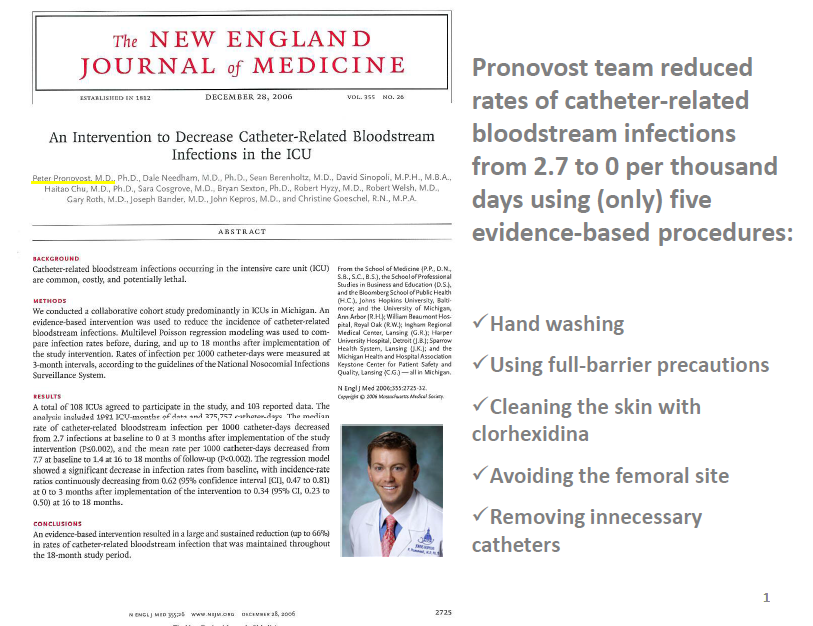
To illustrate what I mean, I have chosen three projects from the sensitive field of hospital infections. The first is from a team of intensive care specialists in Michigan, the second of a group of Spanish intensivists lead by Mutua de Terrassa and the third of a multidisciplinary group from Sevilla.