Showing posts with label Diabetes. Show all posts

Monday, 17 January 2022

Cross-functional units, a challenge within reach

Jordi Varela
Editor


In 2003, a study led by Chris Ham observed that for eleven clinical situations related to chronicity and age, the NHS allocated up to three and a half times more hospital beds than Kaiser Permanente. This was such a surprising result that it generated great admiration for the European health managers by the Californian insurer, especially considering that, according to the researchers themselves, the success of KP lies in the transversal integration of its services, the promotion of self-care, the active role of community nurses and the involvement of physicians to achieve maximum resolution of problems in the framework of primary care.

Monday, 30 October 2017

Prediabetes epidemic in sight


Prediabetes is a terminology that, recently, is used when a person is detected with higher than normal levels of blood glucose, but there is no pathology. Prediabetes could be understood as a disposition to develop diabetes in the future, a disease that, in turn, represents a condition that puts one at risk of serious affections such as nephropathy, retinopathy or cardiovascular disorders, among others. Due to this chain of risks, and with a healthy intention to reduce morbidity and mortality, the American Diabetes Association (ADA) led a study to consider that glycosylated haemoglobin (HbA1c) is a test that can be done without any preparation or need for fasting and see if it can become a new criterion for detecting prediabetes. The concern arises when, according to this diagnostic extension, it’s estimated that in millions of pre-diabetics would show up: in China 493, in the US 86 and in Spain 6, to cite three countries from which I have data.

Monday, 23 February 2015

Coordination, integration (in Spanish Health Care System)


Each of the care system levels has become strong in a particular feature in Spain: in primary care, it has been the role of the gatekeeper; in hospitals, the hierarchization of medical services and in the socio-sanitary area, the offer of post-acute beds. And if we look at what these strengths have been translated into, we will rapidly agree that the primary care has achieved a performance of proximity and effectiveness in prevention, the hospitals have obtained very satisfactory levels of resolution in acute diseases and the socio-sanitary has contributed the essential decompression to the system.

These same strengths, which are certainly well recognized, become rigidities when new requirements that somehow question the status quo, emerge. However, I will demonstrate in 4 examples how the health system has been able to offer imaginative responses, without any hassle:

Monday, 16 June 2014

Personal Health Record


What is it?

A Personal Health Record (PHR) is an electronic resource containing clinical information necessary for people to be able to make decisions with regards to their health. A common feature of the PHR platforms that I have consulted is the accessibility that the patient has to a certain amount of relevant information from his/her medical records (hospital admission reports, emergency reports, lab results, etc.) Additionally there are other remarkable characteristics of PHR, not featured or adopted by all the platforms:
  • Scheduling doctor, nursing and test appointments.
  • Self-monitoring of relevant variables: blood glucose, blood pressure, physical activity, calorific intake, weight, etc. The patient is responsible for maintaining this element of the PHR. It is very useful for ‘at-risk’ and chronic patients.
  • Medication control and prescription management.
  • Access to radiology images. This is a technically sophisticated function often still under development.
  • Secure messaging Mailbox to connect with the healthcare team. See post "E–mail: it starts showing results"
  • Managing insurance policy (only American PHR).

Three American PHR

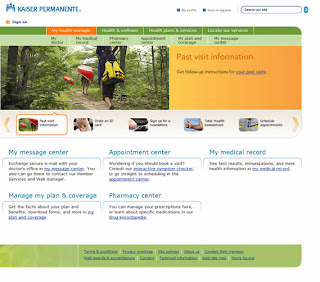
https://healthy.kaiserpermanente.org/health/care/consumer/my-health-manager


http://www.mayoclinic.org/healthmanager/art-20050589

Monday, 2 June 2014

E–mail: it starts showing results

Although the health system is advancing very slowly compared to other industries, I'm sure that people are ready to adopt online services and that the health care system is able to open new lines of communication in accordance with the times we live in. Success is guaranteed, provided that the professionals are willing to adapt, and this is the hard part. No wonder the banking offices and travel agencies, to take two examples, have had to redefine, from head to toe, their business models, thanks to or because of online services.

In this review of a scientific evidence program (in the scanned blue cover), the Department of Veterans Affairs in the U.S. asks the following question: What is the association between 'safe' e-mail and clinical outcomes, the patients satisfaction, the treatment adherence and the efficiency or the resource use?

But first, if I may, I’ll clarify the issue of ‘safe’ e-mail because I think it is relevant. For obvious reasons of security and confidentiality, whenever we speak of using electronic messaging to communicate between a patient and their doctor or nurse, one has to do it through a protected access, which for now is the platform of shared clinical record.

Monday, 26 May 2014

Telehealth, only expectations for now


The technology of data transmission is experiencing an explosion in all areas of social and professional activities and, of course, the specialised industry can see a big opportunity for introducing it as a tool for improving life quality of chronic patients. Doubts, however, appear in the minds of the funders of health services as they see themselves forced to adopt new investments in electronics, which have not yet been able to demonstrate good enough clinical results to compensate the effort.

Seen this way, it seemed to me that in this article about telehealth, it is appropriate to discuss two papers, one English and one Catalan, which aim to answer the question of whether the investment is worthwhile.


This article about findings from the Whole System Demonstrator, project led by Nuffield Trust researchers which sought to evaluate the clinical effect of home interventions with remote data exchange between patients and professionals (telehealth). The project was carried out with the collaboration of 3,230 patients with diabetes, COPD or heart failure from three geographical areas (Cornwall, Kent and Newham) over a 12 month period between 2008 and 2009.

Monday, 7 April 2014

Four ways to make Sutton’s law a reality


It occurs to me that there are four possible approaches to address Sutton's law (remember that this law tells us that we have to go after the waste to raise funds for activities that really provide a health value to people, see post March 28th) and I think we need the four approaches at once:

1. Medical service based on patient preference (see post February 27th)

There is a report from a Cochrane review that says that when patients have contrasting information, other than from their doctor, they have a tendency to choose more conservative therapies within the range that is offered with their diagnosis. And, according to some researchers, up to a 20% reduction in some scheduled surgical procedures can be expected with this method.


2. The role of scientific associations in addressing evidence-based medicine

The difficulties in the practice of medicine begin in the gap that exists between the scientific evidence and the reality of clinical practice. In this area there is a missing link that causes a striking variability in clinical practice and the utilization of health care resources. For this reason, in recent times interesting professional initiatives are being observed (which we will discuss further in later posts), of which highlight "Do not do" from NICE in the UK and "Choosing Wisely” from ABIM Foundation in USA.

Monday, 3 March 2014

Healthcare for diabetics: Is the Spanish model good enough?


Diabetes mellitus type 2 has a prevalence of 8% in the general population and 20% in over 65, and if you consider all the complications that arise, it is clear that this is a chronic disease that occurs most in everyday life of health systems. So, having the issue of diabetes well addressed is very important.

The Spanish model of primary health care included, since the beginning of its reform in the early 80s, a holistic model of diabetes care, with timely support from the endocrinologists and probably for this reason, the results recorded today are very satisfactory. See it in the OECD report of 2011, that when the rate of hospitalisations for admissions due to poorly controlled diabetes is analysed, Spain shows the lowest rate out of a group of 24 countries.


On the left side of the graph, where the accumulated data is, we can see that the admission of 3.3 per hundred thousand inhabitants and the year recorded in Spain represents half of the second country on the list, Israel, one-fifth of that of Portugal, one sixth of the U.S. and the UK, and so on, towards the worst performance in the series, which are those of Austria, with admissions of 187.9 per hundred thousand inhabitants a year.