Showing posts with label Therapeutic overacting. Show all posts

Monday, 24 August 2020

Reducing Overprescription with Psychology based Interventions

Pedro Rey


There exits consensus about drug overprescription having become a significant public health problem, both for its health effects and for its budgetary repercussions. The case of the opioid "epidemic" in the United States frequently comes under scrutiny. We must not forget the abuse of benzodiazepines (especially) during hospital treatment or the loss of efficacy of antibiotics due to the development and selection of bacteria that developed resistance due to improper and excessive use. Traditional methods of combating these problems have been to try to educate both the medical profession and patients, to train prescribers or to review prescribing practices and create automated alert systems. However, although in some cases these measures have been relatively successful in the short term, they have also been shown to be not cost-effective, to lose efficacy in the medium term, and to be challenging to transfer to significant interventions.

Monday, 17 February 2020

Is my child hyperactive or is it simply that he is too small?

Pedro Rey


Parents are increasingly worried about their children being been diagnosed with attention deficit hyperactivity syndrome (ADHD). In fact, in the United States, the proportion of children between two and five years who were diagnosed with this syndrome increased by more than 50% from 2007 to 2012. It is estimated that in 2016 the worldwide prevalence of ADHD diagnosis in children under 18 years old was 5% and in the United States, for example, 5.2% of children of these ages take medication. Spain is one of the main consuming countries of methylphenidate, one of the medicines used to treat ADHD, whose consumption has multiplied by more than 30 in the last 15 years.

Monday, 10 February 2020

The topography of overuse

Andreu Segura


More and more voices warn about the damages associated with the excessive use of health services, although those who claim for the negative consequences attributable to precariousness and the cuts suffered by public health still prevail.

Of course, some protests as well maybe relevant since the health damages related to medical and health care are a consequence of both the action and the omission. And it isn't strange that both coexist because, for example, the abuse of imaging tests leads to an increase in the waiting list of patients who are candidates for exploration, so that the higher the proportion of superfluous prescriptions, the more they will be delayed those that are necessary, those whose result can modify the clinical decision for the benefit of the patient.

Monday, 6 January 2020

30% of digestive endoscopies have questionable indications


@varelalaf
In an article in the series "Less is More" by Gastroenterology, three digestiologists, Shaheen, Fennerty and Bergman, after an extensive review of the literature, conclude that 30% of digestive endoscopies have questionable indications. According to the authors, many clinical practice guidelines stimulate the exaggerated consumption of these tests in clinical situations of doubtful indication, such as recommendations for the follow-up of low-risk patients of Barrett's disease (oesophageal reflux), which they say they are "carefully misleading." On the other hand, the prevailing cancer phobia places a lot of pressure on the examination rooms, which are permanently overwhelmed, not only by inappropriate requests but by follow-up guidelines that anticipate the requirements demanded by the clinical practice guidelines themselves.

Monday, 12 November 2018

Should we statinize society?


A 2011 Cochrane review concluded that there was not enough evidence to prescribe statins for people with a cardiovascular risk of less than 20% in 10 years, a claim that was consistent with the British NICE guideline (2006-2008) and with the American Heart Association (2011). The surprise came when, unexpectedly, the 2013 Cochrane review changed its mind and lowered the statin threshold to the 10% risk at 10 years, a recommendation that was quickly adopted by the NICE guidelines.

Strongly opposed to this change of approach, John Abramson (Harvard Medical School), and collaborators, in "Should people at low risk of cardiovascular disease take a statin?" ensure that with the criteria of 2011, in the population over 60 years, it would have been necessary to statin 16% of women and 48% of men, but with the recommendations of 2013 the market was extended to practically all the population of older people, given that age is the most influential cardiovascular risk variable in risk calculators. The authors have reviewed the meta-analysis that led to the change of criteria ("The effects of lowering LDL cholesterol with statin therapy in people at low risk of vascular disease: meta-analysis of individual data from 27 randomized trials") and have reached conclusions that contradict the Cochrane recommendations of 2013:

Monday, 20 August 2018

The ancestral optimism and the perfect storm


The optimism of patients

When people get ill, or are afraid of being ill, as a rule we tend to trust doctors and by extension, health systems. But do we really benefit? A systematic review, developed by researchers from the Centre for Research in Evidence-Based Practice of Bond University (Australia), based on 35 surveys (27,323 patients as a whole) concludes that 88% of people overestimate the real benefits of the clinical actions, while 67% underestimated the adverse effects.

See for example, the expectations of people in being able to reduce the risk of dying from secondary prevention programs for breast, prostate and bowel cancers are far above the real data. The dark part of the bars corresponds to the percentage of respondents who overestimate the benefits of the respective preventive tests, and the crosses on the right indicate for which of them this percentage is equal to or greater than 50%.

Monday, 28 May 2018

Overdiagnosis in depression: there are doors better left closed

Andrés Fontalba


A young Cecilia, aged 13, in Sofia Coppola's brilliant film based on the homonymous novel, "The suicide virgins" advised:

-Obviously doctor, you were never a 13-year-old girl.

It’s obvious that depression in children and adolescents is an important cause of disability and generates great suffering for the person and his or her environment, requiring specific management adapted to the needs of that peculiar age. Based on the severity of this pathology, the availability of effective screening tools in the detection of depression, and a treatment that improves prognosis, the United States Preventive Task Force in 2009 recommended the screening for depression in all adolescents in a medical and integrated with mental health services setting, despite not having any previous trials that would justify this intervention.

Monday, 29 May 2017

Caesarean section as a consumer good


In private medicine in Brazil, the rate of caesarean section has reached 90% of births. In that country, gynaecologists and midwives, if any, have lost the job of helping women to give birth, and some obstetrical clinics only work to schedule and during office hours. Bad research has not helped either. In the year 2000, a team of researchers led by Dr. Mary Hannah revealed that the caesarean section was a safer practice in breech presentations, information that had an almost immediate impact on clinical practice. Four years later it was found that the research had been poorly done and that its conclusions were wrong, but gynaecologists had already lost the skills (not easy) to practice vaginal births for breech babies. The result is that nowadays the breech foetal position is, assumed to be equivalent to caesarean section, despite the lack of evidence that supports the indication.

Monday, 3 April 2017

Overdiagnosis: the case of thyroid cancer


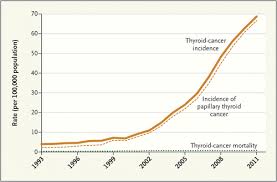
The thyroid cancer rate has doubled or possible tripled in the last twenty years in most Western countries; however there’s a paradigmatic case, according to an article published in New England by Ahn HS and collaborators: South Korea, where this rate has multiplied by fifteen. What has happened in this country? Is there an epidemic? This should not be the case given that when experts analyse specific population mortality (as shown in the chart), this figure remains unchanged. Therefore, everything points to a spectacular case of national over-diagnosis.

The authors explain that many government-encouraged providers offer very attractive and widely accepted preventive packs, including the use of ultrasound and other more sophisticated imaging tests for the early detection of thyroid cancer. It should be clarified that in South Korea, despite there being a national health system, there are co-payments for almost all health activities and as a consequence people pay close attention to the price of combined service offerings.

Monday, 7 November 2016

Basic instruments for clinical management


In preparing this post I have chosen nine references which, in my opinion, have been milestones in the development of methodologies and tools that have shaped clinical management as we understand it today. To make it more understandable, I have framed these milestones in 5 relevant periods: the introduction of the concepts of quality in the 60s, the protocols in the 70s, the consensus in the 80s, the evidence of 90s and the safety of patients in the first decade of this century.


Monday, 26 September 2016

When the overdiagnosis is politicized


Rudy Giuliani, the Republican mayor of New York, on that fateful September 11, at an election meeting said: "I had prostate cancer 5 or 6 years ago and I thank God to be an American citizen because here the probability of survival at five years for this cancer is 82%, while in the UK, due to socialized medicine, this value is only 44%." We must clarify that in the US, PSA screening is widespread while in the UK it’s not so. According to Gerd Gigerenzer (I have extracted this case from his book "Risk Savvy"); Giuliani’s words conceal a big mistake, because in reality, although it seems a contradiction, mortality from prostate cancer in the two countries is practically the same. So how is it possible that the survival rates are so different? To explain it, Gigerenzer describes two biases that encourage the intentional error of the conservative politician: