The model of health services provision is a combination of professional bureaucracy and political-administrative bureaucracy, passed through the filter of organizational rationalization. The fact is that a third (approximately) of clinical processes adapts well and logically, show good results. Let's say: programmed surgical interventions, acute medical pathologies of low-medium complexity, stroke code or heart attack code. So far so good, but it’s inescapable that there are two thirds of the case-mix that don’t fit with the rigidities of what’s offered; we speak, logically, of chronic disease and geriatric frailty, but also of degenerative diseases when they begin to be limiting in the clinically complex processes of difficult labelling. Additionally, in society there are a lot of people in delicate situations, maybe they live alone, maybe they are poor or immigrants or maybe because they live in unstructured environments, to give four examples; people who either don’t access the services or, if they do, they don’t know what to make of them.
Showing posts with label Kaiser Permanente. Show all posts
Monday, 24 September 2018
Monday, 29 January 2018
The old is not an enemy of the new: quality standards for health institutions
This provocative title intends to join the debate that appeared in JAMA this year on what are the quality results that an institution should establish and publish. Common objectives among institutions, from one or different countries for certain diseases selected by international agencies? Or specific objectives of each institution established according to their priorities and the preferences of their professionals?
Professionals from Kaiser Permanente (KP) and from the Department of Veterans Affairs Center (VA) and the Joint Commission Accreditation Agency (JC) disagree. The authors of KP/VA recognize that the measurement and publication of the results of certain prioritized diseases have undoubtedly contributed to the improvement of quality, but they believe that, while continuing to focus on the performance of accounts, it’s necessary to establish innovative formulas for measuring results.
Monday, 15 January 2018
The orientation to the patient: a health service as a "service"
Sophia Schlette
One year ago, while I was still working for Kaiser Permanente, I was invited to give a talk on primary care concepts in an adult education academy in the vicinity of Berlin. I thought I would present a theoretical framework of evaluation, based on evidence, consisting of ten dimensions, similar, but not identical, to the ten building blocks of Bodenheimer already presented in this blog. I arrived on the previous afternoon and saw the participants with a certain air of frustration in being saturated with so much theory. The models and concepts of the talk had little to do with the experience in the German medical practice or with the doctor-patient relationship in real life. In Germany, if you go to the doctor, you have to take half a day off. Wait up to 40 minutes, despite having an appointment just to have 5 precious minutes with the doctor. Typically, neither the doctor nor his employees will give any explanation, nor apologize for the delay. There is no electronic medical record everywhere and where there is, the doctor begins to read it only when the patient is present: “Here’s the recipe. Have a good day. Goodbye” This is the German system, as we know it since childhood.
Monday, 1 May 2017
Primary care: segment to reform?
In a paper published in Health Affairs, Redesigning Primary Care: A strategic vision to improve value by organizing around patients' needs (see commented post) Michael Porter invited us to rethink the organizational model of primary care in accordance with the real needs of the population.
Following the Porterian advice, and just to think a little, it’s worth the excellent Memory of the Catalan Institute of Health (ICS) of 2013, with data from 288 primary health care teams spread throughout the territory, from small local clinics to metropolitan centres with several basic health areas under their care. On page 7 of the document you will see a table elaborated with the attendance of more than 4 million people (who have been visited at least once during the year). The segmentation of this population, grouped with Clinical Risk Group, shows that segments 5, 6 and 7 (different intensities of chronicity) have represented 64.5% of the people who have visited, a group that has consumed 88.8% of the pharmacy and generated 74.7% of urgent hospitalizations (among patients who have been hospitalized two or more times in a year).
Monday, 11 January 2016
Can health community work be of any use?
Great @nytimes article on need for community health workers #CHWs featuring my colleague @prabhjotsinghNY... http://t.co/wShbXqQl46
— Leana Wen, M.D. (@DrLeanaWen) 29 agost, 2014
Dr. Leana Wen, the chosen tweet author and author of the book "When doctors don’t listen", warns her followers that Tina Rosenberg has published an article in the New York Times about what Community Health Workers in the US do. After reading Rosenberg’s article, I thought that this tweet was not a good choice for our readers, as the American reality is a lot different from ours (in Spain). They have a much messier model and therefore they need low cost professionals who can lend a helping hand; in short, poorly paid quasi-volunteers working for charities helping the management of issues such as medication and habits of people living in poverty.
Monday, 4 January 2016
Hospital dependent patients: new cataloguing
In an article published in the New England Journal of Medicine, "Goal Oriented Patient Care," Dr. David Reuben, a geriatric doctor of Ronald Reagan UCLA Medical Center, proposed cataloguing the concept of "hospital dependent patient" such as those patients who a generation before were doomed to die quickly but now, thanks to the combined effectiveness of well coordinated professional teams and availability of technology, their life can be saved but they are unable to return to the previous clinical situation and therefore they enter a state of hospital dependence caused by the same clinical performance that saved their lives. Essentially, we’re not talking about a new disease entity, since most of these patients coincide with the group of chronic complex and/or frail elderly patients.
According to Dr. Reuben, "hospital dependent patients" once hospitalized, can get temporary stabilization, and even an acceptable quality of life, provided they have intensive nurse care, specialists guard teams and adequate resources availability and technological monitoring.
How to spot a "hospital dependent patient"?
Hospital dependent patients’ clinical problems are labile, unstable and unmanageable in the community and, for this reason, their hospitalizations are not avoidable, and herein lies the interest of Dr. Reuben’s cataloguing work.
In contrast, clinical targets for "standard complex chronic patients" focus on community services. These are patients that, if the system is able to offer intense enough programs tailored to their needs, in theory, could avoid hospital readmissions which should be understood as system failures.
Monday, 14 July 2014
Kaiser Permanente: the keys to success
Kaiser Permanente (KP) is an integrated managed care consortium, acting in California, and to a lesser extent on 8 other U.S. states. In the series of "Virtual Clinical Practice" I have already made a brief presentation of the most relevant features of Kaiser Permanente to better understand the development of Health Connect, the electronic medical record of this insurer.
KP Results
What attracts us, European health managers, to KP are their excellent results, both in adjusted resource utilisation as well as in the quality of care which contrasts to the American environment where inequities in access, organisational and medical performance disorder prevails. To illustrate what I mean I have chosen this article:
KP Results
What attracts us, European health managers, to KP are their excellent results, both in adjusted resource utilisation as well as in the quality of care which contrasts to the American environment where inequities in access, organisational and medical performance disorder prevails. To illustrate what I mean I have chosen this article:
Monday, 16 June 2014
Personal Health Record
What is it?
A Personal Health Record (PHR) is an electronic resource containing clinical information necessary for people to be able to make decisions with regards to their health. A common feature of the PHR platforms that I have consulted is the accessibility that the patient has to a certain amount of relevant information from his/her medical records (hospital admission reports, emergency reports, lab results, etc.) Additionally there are other remarkable characteristics of PHR, not featured or adopted by all the platforms:
- Scheduling doctor, nursing and test appointments.
- Self-monitoring of relevant variables: blood glucose, blood pressure, physical activity, calorific intake, weight, etc. The patient is responsible for maintaining this element of the PHR. It is very useful for ‘at-risk’ and chronic patients.
- Medication control and prescription management.
- Access to radiology images. This is a technically sophisticated function often still under development.
- Secure messaging Mailbox to connect with the healthcare team. See post "E–mail: it starts showing results"
- Managing insurance policy (only American PHR).
Three American PHR
Monday, 9 June 2014
The informed medical decision making
In this post, I’ll discuss some initiatives that began in the U.S. long before the emergence of the internet, but now, with the explosion of communication channels and social networks, these have taken on an impressive dimension that I’d like to bring to your knowledge and appreciation because, as we stand today in our environment, we are very far from these advances.
Healthwise is a U.S. company offering all kinds of solutions helping healthy people to better preserve their health and patients to better understand their disease. Many assurances, such as Kaiser Permanente, are offering Healthwise products and solutions to their members, with the aim of supporting policies of empowerment.
Monday, 2 June 2014
E–mail: it starts showing results
Although the health system is advancing very slowly compared to other industries, I'm sure that people are ready to adopt online services and that the health care system is able to open new lines of communication in accordance with the times we live in. Success is guaranteed, provided that the professionals are willing to adapt, and this is the hard part. No wonder the banking offices and travel agencies, to take two examples, have had to redefine, from head to toe, their business models, thanks to or because of online services.
In this review of a scientific evidence program (in the scanned blue cover), the Department of Veterans Affairs in the U.S. asks the following question: What is the association between 'safe' e-mail and clinical outcomes, the patients satisfaction, the treatment adherence and the efficiency or the resource use?
But first, if I may, I’ll clarify the issue of ‘safe’ e-mail because I think it is relevant. For obvious reasons of security and confidentiality, whenever we speak of using electronic messaging to communicate between a patient and their doctor or nurse, one has to do it through a protected access, which for now is the platform of shared clinical record.
Monday, 19 May 2014
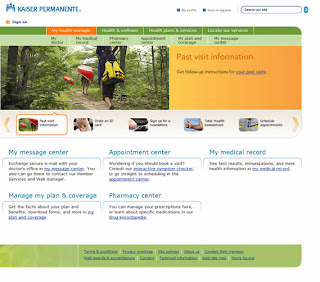
HealthConnect: an electronic health record oriented to value
HealthConnect is Kaiser Permanentes’ name for their electroni health record (EHR), but first allow me to give you a brief presentation of this American insurance, so admired among health managers specially the European ones.
Brief overview of Kaiser Permanente
In 1933 Dr. Sydney Garfield established a prepaid health plan model for workers on an aqueduct in California’s desert. Later, in 1938, Henry Kaiser persuaded Dr. Garfield to extend the experience to other groups of workers, both in California and Washington. Immediately after the war ended, in 1945, the Kaiser-Garfield health plans opened to the general public. These health plans were based, in the beginning, on a reciprocal prepaid model, a care group practice, a population view of prevention and shared clinical information. This pattern contrasted sharply with other policies, in a country that represented and continues to represent the epitome of payment per service.
Today, Kaiser is an insurance that functions through a stable agreement with a doctors’ company called Permanente. It has 9 million members in 9 states, 36 hospitals, 533 health centres, 170,000 employees plus 16,000 physicians in Permanente, a budget of $48,000 M and $2,000 M of benefits (2011).
Friday, 4 April 2014
Waste due to clinical management according to Berwick and Halvorson
The authors believe that the overall savings of the system could be in a range going from 21% to 47%, but if you read the article carefully and ignore the parts about the complexities specific to the American system, it turns out that the estimate obtained out of the waste due to clinical errors, poor coordination between levels of care and overtreatment, would be as indicated in the chart above, at an average value of 13% and a range that would go from 12 to 16%.
Friday, 28 March 2014
Wennberg: ten thoughts about chronic care
In Chapter 12 of his book "Tracking Medicine", John Wennberg reflects on how the American health system is treating chronic patients and, as I think it is a careful and timely analysis, I want to dedicate this post to comment these reflections.
First thought
Blind trust in hospital medicine does not work for the chronically ill patients
It is considered that Medicare spends 18% of its budget on hospital admission bills during the last two years of life of chronic patients. While it is true that overactive hospitals can add some days to the lives of chronic patients, the question is what is the quality and how big is the suffering... and at what cost.
Second thought
Sutton's law: If you are interested in saving money, have no doubt that the saving is to be found in hospitals
Willie Sutton was a bank robber, and when asked why he did it, he answered: "That's where the money is, right?". Wennberg proposes a strategy for implementing Sutton’s law in a less bleeding way: benchmarking. I mean, if you get the hospitals that admit more chronic patients to reduce these rates to levels of those hospitals who admit less, you could raise enough money for community programs more tailored to the needs of these patients, and also could really make a saving.
First thought
Blind trust in hospital medicine does not work for the chronically ill patients
It is considered that Medicare spends 18% of its budget on hospital admission bills during the last two years of life of chronic patients. While it is true that overactive hospitals can add some days to the lives of chronic patients, the question is what is the quality and how big is the suffering... and at what cost.
Second thought
Sutton's law: If you are interested in saving money, have no doubt that the saving is to be found in hospitals
Willie Sutton was a bank robber, and when asked why he did it, he answered: "That's where the money is, right?". Wennberg proposes a strategy for implementing Sutton’s law in a less bleeding way: benchmarking. I mean, if you get the hospitals that admit more chronic patients to reduce these rates to levels of those hospitals who admit less, you could raise enough money for community programs more tailored to the needs of these patients, and also could really make a saving.
Friday, 7 March 2014
Femur fractures. Could its incidence be reduced?
Femur fractures represent a major health issue burden for healthcare systems as it is estimated that one in 20 people will have a femur fracture throughout their lives. According to the 2005 issue of the Atlas de Variaciones en la Práctica Clínica and a subsequent document linked to the same organism (Bernal 2009), the incidence of femur fractures in Spain is 511 new cases per year per 100,000 inhabitants, with a gender distribution clearly tilted towards women (2.6 times). The incidence in Catalonia is the highest, 623, while in Galicia is the lowest, 317.
Although it’s believed that the incidence of femur fracture has little variability, note that the autonomous region that has the highest figure is almost twice of the lowest and on the other hand, if we carefully analyse the Bernal document, we can see that there are certain lifestyles that have a clear impact on the frequency of femur fractures, such as the following finding: if older people are living in a residence, they are three times more likely to break their femur that if living in their own house.
The incidence correlates with hospitalisation in 99% of cases
Subscribe to:
Posts (Atom)


+11.10.20.png)